One of the days we were in Cairo - I can't remember exactly which one - we were taking the metro to Mar Gerges where the very old churches are. Among which, of course, the Hanging Church that is built on top of old Roman city walls.

But first, we walked over to the Egyptian Museum from our hotel in the morning; over the bridge Kobry Al-Galaa, straight across the island Al-Gezira in the middle of the Nile, and then over the bridge Kobry Qasr Al-Nil with its huge iron lions guarding the crossing over the Nile.
It was still the holidays, and a little too early for the streets to be crowded Cairo style, but the streets of Cairo are never empty.
Much of the sky was whitened out by thin strands of smog; the sun shone through hazily, tossing glittery silver reflections over the surface of the river.
We got to the museum and did the whole bottom floor thinking we had endless energy resources, but quickly became too tired to do much more than the Royal Mummy Room (morbid, I know) and Tut Ankh Amon's treasures on the second floor.
If you haven't been, it's a huge museum with hundreds of thousands, if not millions, it seems, of ancient artifacts and it would probably take at least two days to do the whole museum.

Anyway, after the national dish koshary for me, and KFC for Tarek, we went under ground on Midan Tahrir to take the metro to Mar Gerges.
Tarek, thinking that it's Egypt and that they're probably not very particular with the non-smoking signs on the walls, walked under with his cigarette still in his mouth and placed himself in the middle of the hall while I was trying to figure out which line to take, when suddenly two or three white-clad Egyptian police officers walked up to him, looking for trouble.
"Where are you from?"
"From here," Tarek replied, probably without thinking at all. Or maybe, remembering what I had kept telling him: "Pretend that you're Egyptian when you barter in the souq." To get good prices.
But that only goes for the souq!
You see, as is illustrated repeatedly in the movie 'Asal Eswed that I was telling you about the other day, Egyptians don't exactly get treated very well by the police in Egypt. But wave a foreign passport, and you'll get away with pretty much everything.
That is to say, unless your passport is Palestinian.
The police officers ordered Tarek to put out the cigarette immediately, and when he couldn't produce an Egyptian ID and they realized that he had lied about his nationality (why oh why did he say he was Egyptian?), they ordered him to give them his passport ("Palestinian?!") and follow them to their small security room beside the turnstiles.
I was nervous like hell. Being Palestinian in any part of the world is not exactly popular; being Palestinian in a country that shares a border with the outdoors prison of Gaza, that is constantly fighting radical Islamists (and not-so-radical Islamists as well, mind you), and that is overrun by secret and military police, is potentially dangerous.
I followed.
Inside the small room, that had a desk, a chair behind the desk, a chair in front of it, and nothing much else, a man in civilian clothes looked at Tarek's passport while (ironically enough) smoking a cigarette under the glaring white neon light.
They reprimanded him a little for lying about his nationality, told him he had to go and pay a fine of 15 gineh (a little less than 3 US dollars) for smoking in the metro, and come back with the receipt to get his passport back.
And then the police officer who had done the talking outside pulled him aside and suggested that he pay the fine directly to him instead.
The corruption! Charming from a distance, perhaps, when you see people bribing police officers with a gineh or two. Not so much so when you're standing face-to-face with it in a security room under ground, though.
Tarek, in a way of trying to the officer an anti-corrpution lesson, did not give him any money, but went to pay the fine and came back with the official receipt.
The police officer handed back his passport, perhaps a little reluctantly, but we parted with smiles and well-wishes and headed to the ticket sales window to buy our tickets to go see the Hanging Church.

Disaster averted. All is well that ends well.


An opening in the floor of the Hanging Church, showing why it has been named the Hanging Church
But first, we walked over to the Egyptian Museum from our hotel in the morning; over the bridge Kobry Al-Galaa, straight across the island Al-Gezira in the middle of the Nile, and then over the bridge Kobry Qasr Al-Nil with its huge iron lions guarding the crossing over the Nile.
It was still the holidays, and a little too early for the streets to be crowded Cairo style, but the streets of Cairo are never empty.
Much of the sky was whitened out by thin strands of smog; the sun shone through hazily, tossing glittery silver reflections over the surface of the river.
We got to the museum and did the whole bottom floor thinking we had endless energy resources, but quickly became too tired to do much more than the Royal Mummy Room (morbid, I know) and Tut Ankh Amon's treasures on the second floor.
If you haven't been, it's a huge museum with hundreds of thousands, if not millions, it seems, of ancient artifacts and it would probably take at least two days to do the whole museum.

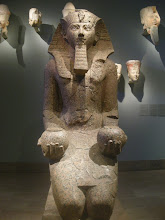
Some Pharao outside of the Egyptian Museum in Cairo
Anyway, after the national dish koshary for me, and KFC for Tarek, we went under ground on Midan Tahrir to take the metro to Mar Gerges.
Tarek, thinking that it's Egypt and that they're probably not very particular with the non-smoking signs on the walls, walked under with his cigarette still in his mouth and placed himself in the middle of the hall while I was trying to figure out which line to take, when suddenly two or three white-clad Egyptian police officers walked up to him, looking for trouble.
"Where are you from?"
"From here," Tarek replied, probably without thinking at all. Or maybe, remembering what I had kept telling him: "Pretend that you're Egyptian when you barter in the souq." To get good prices.
But that only goes for the souq!
You see, as is illustrated repeatedly in the movie 'Asal Eswed that I was telling you about the other day, Egyptians don't exactly get treated very well by the police in Egypt. But wave a foreign passport, and you'll get away with pretty much everything.
That is to say, unless your passport is Palestinian.
The police officers ordered Tarek to put out the cigarette immediately, and when he couldn't produce an Egyptian ID and they realized that he had lied about his nationality (why oh why did he say he was Egyptian?), they ordered him to give them his passport ("Palestinian?!") and follow them to their small security room beside the turnstiles.
I was nervous like hell. Being Palestinian in any part of the world is not exactly popular; being Palestinian in a country that shares a border with the outdoors prison of Gaza, that is constantly fighting radical Islamists (and not-so-radical Islamists as well, mind you), and that is overrun by secret and military police, is potentially dangerous.
I followed.
Inside the small room, that had a desk, a chair behind the desk, a chair in front of it, and nothing much else, a man in civilian clothes looked at Tarek's passport while (ironically enough) smoking a cigarette under the glaring white neon light.
They reprimanded him a little for lying about his nationality, told him he had to go and pay a fine of 15 gineh (a little less than 3 US dollars) for smoking in the metro, and come back with the receipt to get his passport back.
And then the police officer who had done the talking outside pulled him aside and suggested that he pay the fine directly to him instead.
The corruption! Charming from a distance, perhaps, when you see people bribing police officers with a gineh or two. Not so much so when you're standing face-to-face with it in a security room under ground, though.
Tarek, in a way of trying to the officer an anti-corrpution lesson, did not give him any money, but went to pay the fine and came back with the official receipt.
The police officer handed back his passport, perhaps a little reluctantly, but we parted with smiles and well-wishes and headed to the ticket sales window to buy our tickets to go see the Hanging Church.

Disaster averted. All is well that ends well.



 Posts
Posts